
Virginia Contractor License Classes Explained: Class A vs. Class B vs. Class C
One of the first decisions you'll make when applying for a Virginia contractor license is choosing the right license class.
Virginia offers three contractor license classes: Class A, Class B, and Class C. Your license class determines the maximum size of projects your business may perform, while your contractor specialty determines the type of work you're licensed to perform. The three classes also have different experience, financial, and examination requirements.
Before choosing a license class, it's important to understand the Virginia contractor license monetary limits, since selecting the wrong class could limit the projects your business can legally accept.
How Virginia Contractor License Classes Work
Many new contractors assume their license class determines whether they can perform residential, commercial, roofing, or home improvement work.
It doesn't.
Your license class determines the dollar value of projects your business can perform, while your classification or specialty determines the type of work you're licensed to perform. For example, a contractor with a Residential Building Contractor (RBC) specialty performs different work than a Home Improvement Contracting (HIC) specialty, even if both hold the same license class.
Before selecting your specialty, it's helpful to understand the differences between classifications so you choose the license that matches the work you plan to perform.
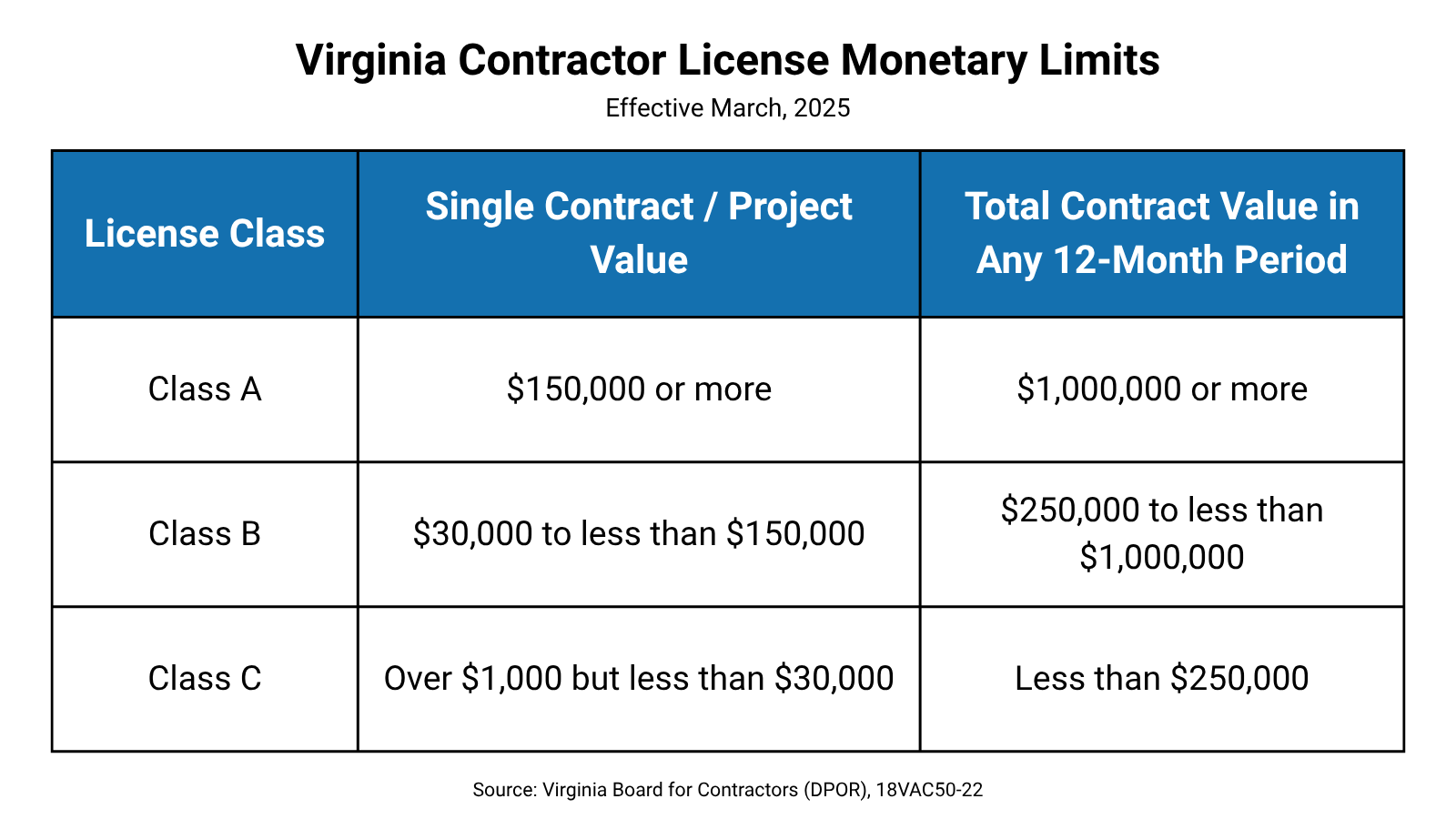
Virginia Class A, Class B, and Class C contractor licenses differ based on project value, total contract value during a 12-month period, experience requirements, financial requirements, and examination requirements.
Class C Contractor License
A Class C contractor license is typically the starting point for smaller contracting businesses.
Class C contractors may perform smaller residential, commercial, or specialty projects as long as they remain within Virginia's monetary limits.
If you're unsure whether your projects fit within a Class C license, review the current Virginia contractor license monetary limits before applying.
The Qualified Individual for a Class C license must have at least two years of experience in the classification or specialty for which they will serve as the qualifier.
Unlike Class A and Class B applicants, Class C applicants are not required to submit a financial statement or surety bond as part of the application process.
Class C applicants are also not required to take the Virginia Business and Law Examination, although many specialties still require a technical examination.
Class B Contractor License
A Class B contractor license allows businesses to perform larger construction projects than a Class C license.
Contractors applying for a Class B license should first determine whether their anticipated projects will exceed the Virginia Class C monetary limits, since many growing businesses eventually need to upgrade from Class C to Class B.
Class B applicants must demonstrate at least $15,000 in net worth or equity through the required financial documentation. As an alternative, the business may submit the Board's $50,000 surety bond.
The Qualified Individual must have at least three years of experience in the applicable classification or specialty.
They must also pass the Virginia Business and Law Examination before submitting their contractor license application.
Like every contractor license class, applicants must also document qualifying construction experience that relates to the specialty they're applying for.
Class A Contractor License
A Class A contractor license is the highest contractor license class available in Virginia.
Unlike Class B and Class C licenses, Class A has no monetary limits on individual contracts or annual project volume.
Class A applicants must demonstrate at least $45,000 in net worth or equity through the required financial documentation. As an alternative, the business may submit the Board's $50,000 surety bond.
The Qualified Individual must have at least five years of experience in the applicable classification or specialty.
Virginia also offers an expedited application option for eligible Class A applicants. Expedited processing is not available for standard Class B or Class C applications.
Like Class B applicants, Class A applicants must pass the Virginia Business and Law Examination before applying.
Financial Statement vs. Surety Bond
Class A and Class B applicants must demonstrate financial responsibility as part of the Virginia contractor license application.
Class B businesses must demonstrate at least $15,000 in net worth or equity, while Class A businesses must demonstrate at least $45,000.
Applicants may satisfy the financial verification requirement using the appropriate financial statement documentation or, as an alternative, submit the Board's $50,000 surety bond.
Class C applicants do not have this financial verification requirement.
Which Contractor License Class Should You Choose?
Choosing the right contractor license depends on more than the size of your business today.
Ask yourself:
What is the largest project I expect to perform?
Will my annual work exceed the limits of a lower license class?
Do I expect my business to grow within the next few years?
Some businesses begin with Class C and later change license classes as their project sizes and business volume grow. Others apply for Class B or Class A initially because their anticipated work requires the higher class.
Reviewing the six steps to getting a Virginia contractor license before beginning the application process can help you understand when you'll choose your license class and what documentation you'll need throughout the process.
Common Mistake
One of the biggest misconceptions is believing that a Class A license allows every type of contracting work. It doesn't.
A contractor's license class determines project size. A contractor's classification or specialty designation determines the type of work they may legally perform.
Understanding both is essential before completing your application.
Frequently Asked Questions
-
Yes. Virginia allows licensed contractors to apply for a change in license class. You'll need to meet the requirements of the new class, including any applicable experience, examination, and financial requirements.
-
No. Class A and Class B have business examination requirements that do not apply to Class C. Depending on the classification or specialty, a Qualified Individual may also be required to pass a technical examination.
-
No. Financial verification is required for Class A and Class B applicants. Class C applicants do not have the same financial verification requirement.
-
Start with the value of the individual projects you expect to perform and your total contract volume during a 12-month period. Then make sure you can meet the experience, financial, and examination requirements for that license class.