Virginia Residential Building Contractor (RBC) Exam Guide
If you're applying for the Residential Building Contractor (RBC) classification in Virginia, you'll need to become familiar with the Residential Building Contractor (RBC) technical examination.
Unlike the Virginia Class A Contractor Exam Guide, which focuses on business, law, and project management, the RBC examination focuses on residential construction.
Because the examination is open book, preparation isn't only about knowing construction concepts. Successful candidates should also become familiar with the approved reference materials so they can locate information efficiently during the examination.
What Is a Residential Building Contractor (RBC)?
The Residential Building Contractor (RBC) classification authorizes contractors to perform work involving the construction, remodeling, repair, improvement, removal, or demolition of dwellings, townhouses, and their accessory structures, as defined by Virginia regulations.
The classification does not include electrical, plumbing, HVAC, or gas fitting work unless the contractor also holds the appropriate specialty classification.
If you're still deciding which contractor license classification is right for your business, see Virginia Contractor License Classes Explained.
RBC Exam at a Glance
The Virginia Residential Building Contractor examination consists of:
80 scored questions
160-minute time limit
70% passing score (56 correct answers)
Open-book examination
What Topics Are Covered?
The official Candidate Information Bulletin divides the examination into multiple residential construction subject areas.
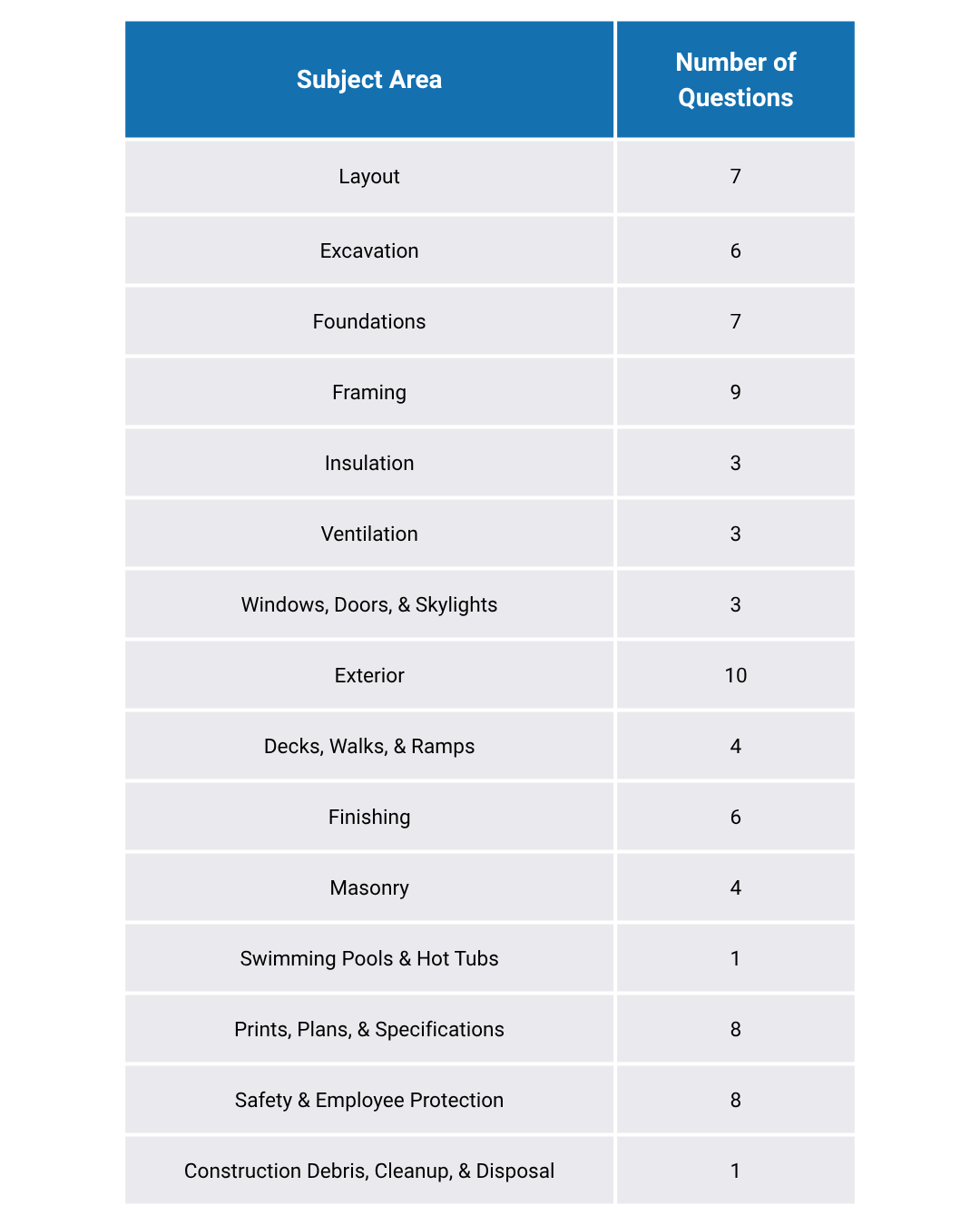
Virginia Residential Building Contractor (RBC) exam content outline showing the subject areas and approximate percentage of questions on the exam.
One thing that surprises many applicants is how broad the examination is.
For example, the content outline includes topics such as swimming pools and hot tubs. While many Residential Building Contractors may never perform this type of work, the examination covers a broad range of residential construction topics that fall within the RBC classification.
Because of that, preparation involves more than reviewing the type of work you perform every day. Becoming familiar with the approved reference materials can help you locate information across a wide variety of residential construction topics.
Understanding the Open-Book Format
The Virginia Residential Building Contractor examination is an open-book examination.
Candidates are responsible for bringing the approved reference materials listed in the official Residential Building Contractor Candidate Information Bulletin (CIB).
PSI allows candidates to prepare their books before the examination. According to the Candidate Information Bulletin:
Permanent tabs are permitted.
Highlighting is permitted.
Underlining is permitted.
However:
Handwritten notes are not permitted.
Loose papers are not permitted.
Removable sticky tabs or flags are not permitted.
Becoming familiar with the organization of your reference books before exam day can save valuable time during the examination.
Understanding the Virginia Code References
The approved reference materials for the Residential Building Contractor (RBC) exam include both International Code Council (ICC) publications and Virginia-specific code references.
For the Residential Building Contractor (RBC) exam, you have two common options for using the residential code:
2021 International Residential Code (IRC) plus the Virginia Uniform Statewide Building Code (USBC) amendments, or
The fully integrated 2021 Virginia Residential Code (VRC) published by ICC, which combines the IRC with Virginia's adopted amendments into one book.
Both options contain the Virginia requirements used for the examination. Many contractors who already own the 2021 IRC choose to use it with Virginia's free USBC amendment document, while others prefer the convenience of using the fully integrated Virginia Residential Code (VRC).
If you're new to Virginia's building codes, these articles explain the differences:
Virginia Requirements Take Priority
The Virginia Contractor Specialty Candidate Information Bulletin includes an important rule regarding examination questions.
If a question could have different answers because information conflicts between reference materials, legal requirements take precedence over non-legal references.
If two legal requirements appear to conflict, Virginia's state-specific code, law, or regulation takes precedence over the national requirement.
This is one reason it's important to become familiar with Virginia-specific references when preparing for the examination.
Experimental Questions
The Virginia Contractor Specialty examinations may include 5 to 10 experimental questions in addition to the scored examination questions.
These questions are being evaluated for possible use on future examinations and do not affect your score.
Candidates are not told which questions are experimental, so every question should be answered to the best of your ability.
Approved Reference Materials
The official Residential Building Contractor Candidate Information Bulletin (CIB) contains the approved reference materials for the examination.
The bulletin also identifies:
Approved code editions
Examination policies
Reference material rules
Permitted tabs and highlighting
Testing procedures
Always verify you're using the current Candidate Information Bulletin and the correct code editions before preparing for the examination.
Frequently Asked Questions
Do I need experience in every topic listed on the exam outline?
No.
The exam covers a broad range of residential construction topics within the Residential Building Contractor classification. It's common for contractors to encounter topics they don't perform regularly, which is why becoming familiar with the approved reference materials is an important part of exam preparation.
Can I use newer editions of my reference books?
In many cases, yes—but not always.
The Candidate Information Bulletin explains which editions are accepted and includes guidance for newer editions of many non-code references. Code books, however, must match the editions specified for the examination. Always verify the current requirements before exam day.
What happens if two reference books have different answers?
If a question involves conflicting information, legal requirements take precedence over other references. If two legal requirements conflict, Virginia's state-specific code, law, or regulation overrides the national requirement.
Can I highlight and tab my books?
Yes.
Permanent tabs, highlighting, and underlining are permitted. Handwritten notes, removable tabs, and loose papers are not permitted. Always review the current Candidate Information Bulletin for the complete reference material rules before your exam.
Common Mistakes to Avoid
Assuming the exam only covers the type of residential work you perform every day.
Waiting until exam day to learn how your reference books are organized.
Bringing the wrong code editions or outdated reference materials.
Adding handwritten notes or prohibited tabs to your books.
Forgetting that Virginia-specific requirements take precedence when reference materials conflict.